Time’s up for
Palm Oil
It’s the ultimate convenience ingredient. It makes things crispy. It’s easy to use. It’s cheap. It’s fine at room temperature. It doesn't get bad.
But here is the inconvenient truth: the other side of the coin is increasingly bad for nature, as well as people. Both workers and consumers.
-
Palm oil is everywhere. You find it in nearly half of all packaged supermarket products, from snacks and baked goods to soaps and shampoos (footnote 1). Apart from being great to use, it is also incredibly productive per hectare. That efficiency is exactly why global demand has surged. In a few decades, production has gone from a niche commodity to one of the most traded and most used vegetable oils on the planet. In 1970, 2 million tonnes of palm oil were produced annually. By 2025, that figure was close to 80 million tonnes (footnote 2).
Unfortunately, the risks are hard to ignore: deforestation and biodiversity loss, land grabbing, and a growing health debate around ultra-processed foods.
And that is where the trouble begins.
Palm oil often appears in small amounts across a wide assortment: ready-made meals, snacks, bakery, spreads, confectionery. It also hides in non-food items such as detergents, soaps and personal care products. It has a way of showing up again and again — in a glaze, a filling, a flavour carrier, or a functional additive.
That complexity is not a reason to accept the status quo. It is a reason to take traceability seriously.
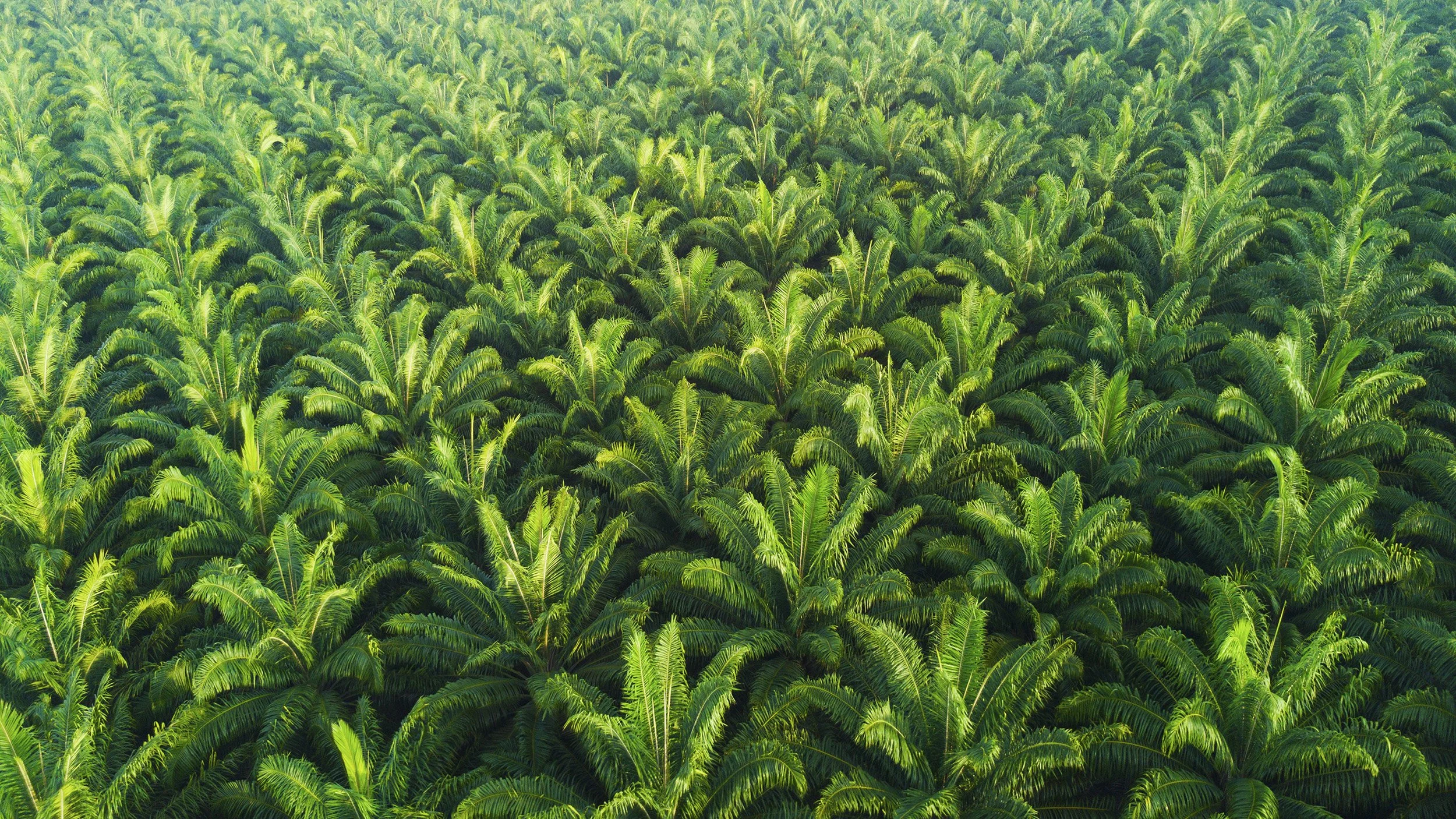
Palm oil is closely linked to land-use change in tropical regions. And when tropical forests fall, we do not just lose trees — we lose carbon sinks, habitats, and water systems that entire communities depend on. In some hotspots, palm oil expansion has been a dominant driver of forest loss, pushing already fragile ecosystems closer to collapse.
This is also a climate problem. When forests are cleared, the carbon they store is released. When peatlands are drained, emissions can spike even further. The climate impact is built into how palm oil has expanded.
Then there is land grabbing. Palm oil is one of the commodities where the risk of commercial interests displacing local people from their own land is greatest. This is what “cheap” looks like when someone else pays the bill.
And besides land conflicts and displacement of indigenous and local communities, there are other serious social issues for the people getting work. Labour abuses, including forced labour and child labour, are present in some contexts. These risks are not hypothetical. They are repeatedly documented across the broader sector.
At the same time, palm oil also supports livelihoods. Millions of smallholders depend on it for income. So, for the industry as a whole, the challenge is not simply “palm oil: yes or no.” Substituting one commodity for another can simply shift the impact elsewhere, to different deforestation frontiers, into new pressures on land and water. The real question, therefore, is: what kind of production are we rewarding — and what kind are we willing to walk away from?
Last but not least, there is the health question. The processing of palm oil delivers, among other things, 3-MCPD, which is carcinogenic and affects liver function and fertility, especially in men. EFSA, the European Food Safety Authority, considers that current exposure is safe for most people but "may pose health risks to younger people with high intakes of products containing palm oil". The problem is, ultra-processed foods, containing lots of palm oil, account for an increasing share of our diet across Europe (up to 50 per cent of calories for some). So “high intake” is a reality for many.
If a supplier cannot tell you where the palm oil comes from, how it was processed, and what controls are in place. That is a blind spot.
Convenience businesses are part of the food retail sector. We may not be the largest players, but our assortments are big and the choices we make can still influence the market. We believe that:
The pressures on the industry need to be reduced so that palm oil can be grown on a smaller scale, with surrounding land rehabilitated and the profits from cultivation benefiting local people.
The current palm oil industry fuels a global food system that is becoming a public health risk in our part of the world.
The convenience sector as a whole benefits from shifting from more highly processed, long-shelf-life products to fresher options. This also means a lower overall need for palm oil.
At Reitan Convenience, we have decided to phase out palm oil from our assortment. Is it easy? Of course not. Is it the only way? Not at all. It’s a complex issue. Certification systems are improving, and many actors across the industry are working hard to make palm oil production more sustainable. At the same time, the scale of environmental damage already done means that nature will not recover unless the pressure on ecosystems is reduced.
We think it is important to both diversify and grow existing viable alternatives. In our categories, particularly food and snacks, we see opportunities to do exactly that. Our ambition is therefore to support existing alternatives and also find new ones that reduce the need for further deforestation.
We do not claim this will solve everything, but we believe companies like us need to keep pushing for real change rather than relying only on incremental improvements.
For us, in practice, it means:
Phasing out palm oil in all edible products sold in our stores. We have set the deadline to the end of 2028
Making sure that the alternatives are living up to our sustainability standards as defined in our Code of Conduct
Being honest about trade-offs, and refusing greenwashed shortcuts
Because palm oil is not just an ingredient. It is an ecosystem-, climate- and social challenge. In a world of accelerating volatility driven by climate disruption, tightening regulation, and rising consumer scrutiny, we think it should be on the agenda.
Nothing here is simple. But doing nothing is not neutral. It is a choice — and it is a choice we can no longer afford.
Footnotes:
1. https://wwfcee.org/partnerships/partnership-for-sustainable-food/7-things-to-know-about-palm-oil
2. https://apps.fas.usda.gov/psdonline/circulars/oilseeds.pdf
Share this content!
KEEP EXPLORING